Local SEO vs. International SEO: Key Differences, Architecture, and Strategy
Key takeaways
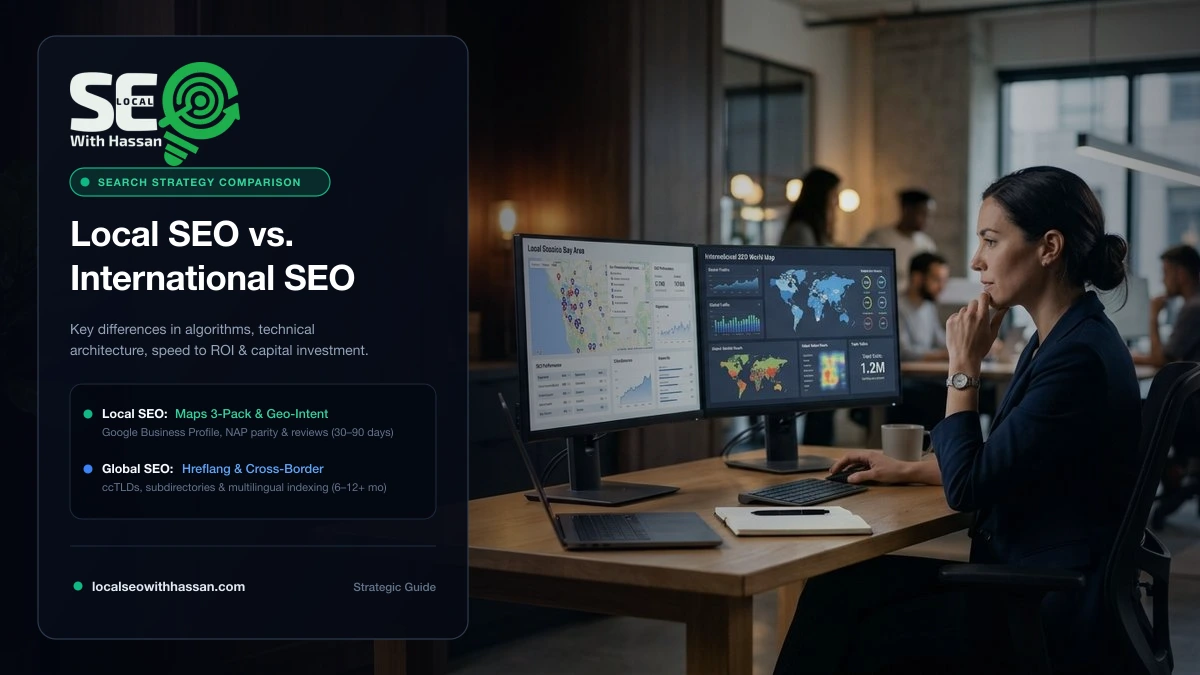
- Local SEO targets high-intent buyers in a defined physical radius via Google Maps and localized entity signals, while International SEO captures cross-border or multilingual search demand across countries.
- Local SEO relies heavily on Google Business Profile, proximity, NAP consistency, and local reviews; International SEO requires strict URL structure (ccTLDs vs subdirectories) and bidirectional hreflang tags.
- Local campaigns generate direct calls and revenue within 30 to 90 days, whereas international organic campaigns require 6 to 12+ months of content scaling and domain authority building.
When business owners and marketing directors evaluate search engine optimization, they frequently ask whether they should invest in Local SEO or International SEO. While both disciplines share foundational principles like crawlability, keyword research, and user experience, their execution, algorithms, and conversion mechanics could not be more different.
Optimizing a private medical clinic in Lahore, a dental practice in Sydney, or an equipment rental depot in the San Francisco Bay Area requires an entirely different technical stack and ranking playbook than scaling an international SaaS platform, a global consulting practice, or a multi-country e-commerce brand.
Here is a comprehensive breakdown of how Local SEO and International SEO function, how their underlying algorithms operate, the technical infrastructure required for each, and how to determine the exact strategy your business needs.
Direct Answer: What is the difference between Local SEO and International SEO?
AEO Summary: The fundamental difference between Local SEO and International SEO lies in search intent and algorithmic delivery. Local SEO targets searchers within a specific geographic radius, prioritizing Google Maps 3-Pack placement, Google Business Profiles (GBP), name-address-phone (NAP) citations, and customer reviews to generate inbound phone calls and foot traffic. International SEO targets audiences across multiple countries or languages, relying on global organic rankings, ccTLD or subdirectory domain architecture, bidirectional
hreflangcode implementation, and multi-regional backlinks to capture international web traffic and sales.
Strategic comparison: Local SEO vs. International SEO
To see how these two search disciplines diverge across core operational dimensions, review the comparison matrix below:
| Dimension | Local SEO | International SEO |
|---|---|---|
| Primary Audience | Searchers within a physical city, suburb, or defined service area radius | Users located in multiple foreign countries or searching in different languages |
| Search Intent | Immediate commercial intent (“dentist near me”, “emergency plumber Oakland”) | Informational, navigational, or cross-border transactional intent |
| Primary Google Engine | Google Maps Local 3-Pack & localized organic SERP | Global organic web index (Google, Bing, Yandex, Baidu) |
| Core Digital Asset | Google Business Profile (GBP) + Local Landing Pages | Localized domain architecture (ccTLDs, subdirectories, or subdomains) |
| Algorithmic Pillars | Proximity (Distance), Relevance (Categories/Services), Prominence (Reviews/Citations) | Technical accessibility, language relevance (hreflang), regional authority |
| Key Technical Stack | LocalBusiness Schema, geo-coordinates, mobile click-to-call, NAP parity |
hreflang annotations, geo-targeting in Search Console, multi-currency engines, CDNs |
| Authority & Links | Local chambers of commerce, regional directories, local sponsorships, community news | High-authority global domains, country-code TLD backlinks (.co.uk, .de, .ca), international PR |
| Customer Reviews | Critical ranking factor; review count, velocity, and sentiment directly dictate 3-pack rank | Secondary trust signal; onsite testimonials or third-party platforms (Trustpilot) |
| Time to Measurable ROI | 30 to 90 days for profile optimization, citation cleanup, and map movement | 6 to 12+ months for domain authority compounding and multilingual indexing |
| Primary Conversion Goal | Direct phone inquiries, store visits, quote forms, local appointments | Self-service signups, digital downloads, SaaS subscriptions, e-commerce checkouts |
Understanding Local SEO: Dominating your immediate market
Local SEO is the practice of optimizing your online presence to attract business from local customers searching for solutions in a specific geographic area.
When someone searches for a query with local intent—either explicitly (such as “plastic surgeon DHA Lahore”) or implicitly (such as “hair salon open now” while walking down Church Street in Parramatta)—Google splits its search results page into two distinct interfaces:
- The Google Local 3-Pack: A dedicated map module displaying the top three local business profiles, complete with star ratings, phone numbers, review snippets, and driving directions.
- Localized Organic Results: Traditional web links directly below the map pack, customized to reflect local authority and proximity.
The 3 algorithmic pillars of Local SEO
Google evaluates local listings using three primary criteria:
- Relevance: How accurately your business profile and website content match what the searcher is looking for. This is governed by your primary and secondary Google Business Profile categories, your service catalogs, and the topical depth of your localized website pages.
- Distance (Proximity): How close your registered physical address or service area is to the user’s physical GPS location at the moment they execute the search. Proximity is a powerful ranking factor that cannot be faked without risking profile suspensions.
- Prominence: How well-known, trusted, and reputable your business is in the local community. Prominence is built through consistent 5-star customer reviews, review responses, accurate citations across trusted business directories, and localized press mentions.
When does a business need Local SEO?
Local SEO is essential for any business that meets either of the following criteria:
- Brick-and-mortar storefronts: Medical clinics, dental practices, med spas, hair salons, law firms, accounting practices, gyms, and retail dealerships.
- Service-area businesses (SABs): Plumbers, electricians, junk removal services, septic pumping companies, porta potty operators, and mobile contractors who travel to clients within a designated metropolitan zone.
In my client work—from taking a Parramatta hair salon to 2,079 calls in 5 months to helping an unverified DHA Lahore plastic surgeon rank #1 for 7 target keywords—local search delivers the highest conversion rates of any digital marketing channel because searchers are actively ready to book.
Understanding International SEO: Reaching a global audience
International SEO is the process of optimizing your website so search engines can easily identify which countries you want to target and which languages you use to conduct business across borders.
Rather than trying to win a map pin in a specific neighborhood, International SEO focuses on overcoming linguistic, cultural, and technical barriers to compete in national organic search results across multiple sovereign territories.
The 3 architectural pillars of International SEO
- URL & Domain Structure: Deciding how your website separates content for different geographic markets. There are three primary models:
- Country-code Top-Level Domains (ccTLDs): Separate domains for each market (e.g.,
yourbrand.co.uk,yourbrand.ca,yourbrand.de). This provides the strongest geo-targeting signal to search engines but requires building domain authority from scratch on every individual URL. - Subdirectories with a Generic TLD (Recommended for most brands): Housing international content under one authoritative root domain (e.g.,
yourbrand.com/uk/,yourbrand.com/de/). This consolidates all backlink equity into one primary domain while keeping regional sections organized. - Subdomains: Using third-level domains (e.g.,
uk.yourbrand.com,de.yourbrand.com). Subdomains are often treated as separate entities by search algorithms and require dedicated link acquisition.
- Country-code Top-Level Domains (ccTLDs): Separate domains for each market (e.g.,
- Hreflang Implementation: Adding HTML
<link rel="alternate" hreflang="xx-XX" href="..." />tags in the page header, XML sitemaps, or HTTP headers. Hreflang tells Google exactly which language and regional version of a page to display to a searcher in a specific country (e.g.,en-GBfor English speakers in the UK versusen-USfor English speakers in the United States), preventing internal duplicate content conflicts. - True Linguistic & Cultural Localization: High-performing international SEO requires more than running automated Google Translate over your English pages. It demands localized keyword research reflecting regional dialects, search slang, currency units, localized payment preferences, and culturally relevant imagery.
When does a business need International SEO?
International SEO is required when:
- You operate a software-as-a-service (SaaS) product marketed globally.
- You sell physical products via an e-commerce store that ships internationally across North America, Europe, Asia, and Oceania.
- You provide high-ticket consulting, enterprise B2B advisory, or remote digital services across multiple continents.
- Your website produces multilingual content aimed at native speakers of Spanish, German, French, Arabic, or Japanese.
Technical stack comparison: What your website actually needs
The code and technical infrastructure you build depends entirely on which strategy you pursue.
┌─────────────────────────────────────────────────────────────┐
│                    LOCAL SEO TECH STACK                     │
├─────────────────────────────────────────────────────────────┤
│ • Google Business Profile Verification (API & Map Sync)     │
│ • LocalBusiness / MedicalBusiness / Service Schema Markup   │
│ • Exact NAP Consistency (Name, Address, Phone)              │
│ • City & Neighborhood Landing Page Silos                    │
│ • Local Citation Distribution (Aggregators & Data Platforms) │
│ • Click-to-Call Buttons & Fast Mobile Loading               │
└─────────────────────────────────────────────────────────────┘

┌─────────────────────────────────────────────────────────────┐
│                INTERNATIONAL SEO TECH STACK                 │
├─────────────────────────────────────────────────────────────┤
│ • Bidirectional Hreflang Annotations & x-default Fallbacks   │
│ • Country-Specific Domain / Subdirectory Routing            │
│ • Google Search Console International Targeting             │
│ • Global Content Delivery Network (CDN) Edge Caching        │
│ • Dynamic Currency, Tax & Date Formatting Engines           │
│ • Strict Compliance: GDPR, CCPA, and Regional Cookie Laws   │
└─────────────────────────────────────────────────────────────┘
Schema markup: Local vs. International
In Local SEO, structured data is used to anchor your digital entity to a real-world physical location. For instance, using JSON-LD:
{
  "@context": "https://schema.org",
  "@type": "LocalBusiness",
  "name": "Local SEO With Hassan",
  "telephone": "+923116453563",
  "address": {
    "@type": "PostalAddress",
    "streetAddress": "2nd Floor, Quickoffice, 29-D Main Gulberg",
    "addressLocality": "Lahore",
    "addressRegion": "Punjab",
    "postalCode": "54660",
    "addressCountry": "PK"
  },
  "geo": {
    "@type": "GeoCoordinates",
    "latitude": 31.5204,
    "longitude": 74.3487
  }
}
In International SEO, schema markup emphasizes organization-level entity identity, multilingual authorship, and cross-language translation relationships using inLanguage attributes, WebPage declarations, and localized product schemas.
Can a business do both? The hybrid approach
Many growing companies discover they need both Local and International SEO simultaneously.
Consider these real-world scenarios:
- A multi-location boutique hotel group: Like our campaign for an independent hotel in Dorchester, UK, the business relies on Local SEO to capture “hotels in Dorchester” on Google Maps, but also benefits from International SEO to rank in the US and Europe when overseas tourists plan their UK holiday getaways.
- A private aesthetic surgery clinic: A plastic surgery practice in Lahore or Dubai often serves local resident patients through Google Maps, while simultaneously ranking in the UK, US, and Canada for international medical tourism queries.
- Enterprise contractors & franchise groups: Brands operating depots in 20 cities across 3 countries require robust international domain architecture at the root level, coupled with localized Google Business Profiles and localized city pages for every single operating depot.
When building a hybrid search strategy, the golden rule is strict separation of concerns:
- Use your primary domain architecture and international subdirectories (
/uk/,/us/,/au/) to handle global topical authority and organic rankings. - Connect individual Google Business Profiles directly to their respective local landing pages (e.g., linking your Sydney GBP to
domain.com/au/sydney/, not to the generic global homepage). - Ensure every local landing page features distinct, verified NAP details, unique local reviews, and localized schema markup.
Cost, timelines, and expected return on investment
The resource commitment required for Local SEO versus International SEO differs substantially:
Local SEO investment & velocity
- Timeline to initial traction: Typically 30 to 90 days. Because local competition is constrained to a specific geographic territory, fixing profile suspensions, eliminating NAP inconsistencies, updating categories, and earning 15–20 authentic reviews can produce measurable map pack ranking jumps quickly.
- Ongoing maintenance: Focused on steady weekly review generation, Google Business Profile posting, local citation refreshes, and geo-targeted service page updates.
- Conversion cycle: Short. A customer searching for a burst pipe, an emergency dental toothache, or a hair styling appointment usually contacts the business within hours of searching.
International SEO investment & velocity
- Timeline to initial traction: Typically 6 to 12+ months. You are competing against entrenched national incumbents, massive global publications, and established regional brands. Building domain authority, technical crawling parity, and regional backlink equity takes sustained effort.
- Ongoing maintenance: High technical overhead. Managing
hreflangvalidation across hundreds of pages, updating regional translation strings, monitoring separate country performance in Google Search Console, and acquiring backlinks from regional ccTLDs requires consistent technical governance. - Conversion cycle: Medium to long. Global visitors often engage through multiple touchpoints, email nurturing, and extended software trials before purchasing.
Decision framework: Which strategy does your business need?
To choose the right path for your organization, ask these three diagnostic questions:
1. Where does money exchange hands?
If transactions require a customer to visit your physical facility or require your team to dispatch a vehicle to their doorstep, Local SEO is your primary growth lever. Pour your budget into Google Maps, Google Business Profile optimization, local citations, and localized landing pages before touching international search.
If your product or service is delivered digitally, remotely, or shipped via postal freight worldwide, International SEO is your path forward.
2. What does the search engine results page look like?
Open an incognito browser window and search for your primary commercial keywords:
- If Google displays a Google Maps 3-Pack with star ratings, call buttons, and pins, Google has deemed that search query to carry local intent. You must compete via Local SEO.
- If Google returns standard organic web links, video carousels, or broad informational guides, the intent is national or global. You must compete via organic and international SEO.
3. What is your available operational bandwidth?
Attempting International SEO with limited resources often results in thin, poorly translated pages that search engines ignore. If resources are tight, establishing undisputed #1 dominance in your primary city or metropolitan market via Local SEO delivers faster cash flow and immediate client bookings, creating the capital foundation needed to expand internationally later.
Next steps for your search strategy
Whether your business needs to capture high-intent customers in your home metro or scale search visibility across international borders, success starts with an objective baseline audit of your technical infrastructure, backlink profile, and competitive positioning.
If you want to identify the exact search gaps holding your business back on Google, request a free, thorough Local SEO audit. I will inspect your Google Business Profile, examine your website’s technical foundation, analyze your local competitors, and show you exactly where your next high-value inquiries will come from.
Need help with this? Local SEO management is one of my core services.
See how I can help →
Local SEO specialist and team lead. I write about what I see working for local businesses. More about Ali Hassan.