

Used car dealers
SEO and Google Maps for used car dealerships
Car buyers compare inventory, read reviews, and check financing terms across three different lots before ever stepping foot on showroom asphalt. I help independent used car dealers dominate the Google Maps 3-pack, showcase real-time inventory on search, and convert high-intent shoppers into lot visits.
The gaps I usually find
The plan for used car dealers
The services that usually matter most, in the order I'd typically start. Your audit decides the final plan.
- Local SEO managementOngoing map pack tracking, Google Business Profile optimization, vehicle photo publishing, and automotive citation management.Explore Local SEO management →
- Google Business Profile optimizationStorefront GBP setup, Google "Cars for sale" inventory feed connection, primary and secondary category precision, and lot walk-around media.Explore Google Business Profile optimization →
- AI website developmentFast, mobile-first website architecture with crawlable Vehicle Detail Pages (VDPs), Schema.org Vehicle structured data, and frictionless test-drive booking.Explore AI website development →
- Review generationAutomated SMS review requests sent 1 to 2 hours after key handover, collecting genuine 5-star Google reviews from satisfied car buyers.Explore Review generation →
- Missed-call text-back & AI receptionistInstant automated text replies within 15 seconds of any missed call, keeping buyers engaged before they move to a competitor’s lot.Explore Missed-call text-back & AI receptionist →
- Google AdsHigh-intent search campaigns and Google Vehicle Ads (VLA) capturing shoppers actively searching for specific makes, models, and financing in your market.Explore Google Ads →
The local search journey: how modern car buyers choose an auto lot
Today’s used car shoppers do 80% of their research on mobile phones before ever setting foot on a dealership lot. Winning their business requires showing up at the exact moment they compare lots.
Gone are the days when car buyers spent their weekends driving down auto rows hoping to stumble upon the right vehicle. Today, the car-buying journey starts on Google. Shoppers search with high commercial intent: “used car dealership near me”, “used Toyota Tacoma [city]”, “reliable affordable used cars”, or “buy here pay here car lots”.
When those searches happen, Google displays the Local 3-Pack—the three map listings placed prominently above organic search results. Dealerships that occupy these three positions capture over 60% of mobile phone calls, website visits, and driving direction requests.
If your dealership is buried on page two or hidden outside the top three map spots, you are invisible to shoppers ready to buy. They simply call or visit the top-ranked lots down the street. I build and execute local search campaigns that place your dealership firmly in the local 3-pack for high-volume vehicle and dealership searches.
Near Me Searches
Capture ready-to-buy shoppers searching for "used car lots near me" within your primary 15-mile local radius.
Make & Model Queries
Rank for specific vehicle searches like "used Ford F-150 [city]" or "used Honda CR-V near me" through indexable vehicle pages.
Financing & Loan Searches
Attract credit-conscious buyers looking for "bad credit auto financing [city]" and "buy here pay here dealerships".
Proof from a documented multi-location search campaign: Bay Area Sanitation
While automotive dealerships operate physical retail lots, local algorithm mechanics—technical crawlability, localized entity signals, review velocity, and map prominence—follow the exact same principles. Here is documented proof from my campaign for Bay Area Sanitation.
When I took over local search for Bay Area Sanitation in February 2026, the company operated across Northern California but struggled with search visibility outside its home base. High-value search terms like “porta potty rental san jose” sat on page two at #15, and competitive Oakland searches sat down at #9.
I executed a multi-location SEO strategy: restructuring dedicated city landing pages, eliminating technical crawl errors, updating local schema markup, and implementing an aggressive Google Business Profile management routine. The documented results compound steadily across competitive regional markets:
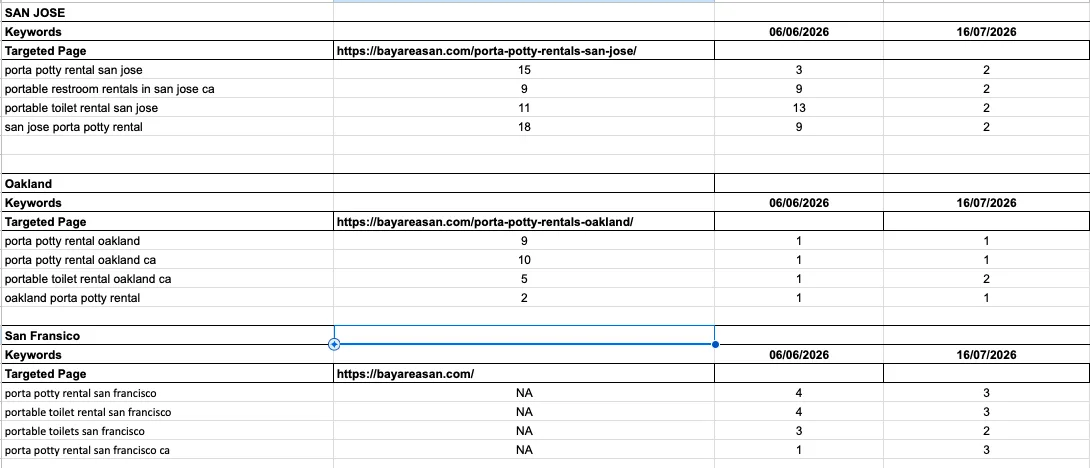
Multi-City Dominance: #1 Across Oakland and #2 in San Jose
Documented keyword ranking progress from the live rank-tracking sheet between campaign launch in February 2026 and July 2026.
- All 8 tracked Oakland keywords reached #1 on Google after just the first month (Feb → Mar 2026).
- Main San Jose keyword jumped from #15 to #2 on Google (Feb → Jul 2026).
- Monthly phone calls grew from 25 to 56 in just two months (June → August 2026).
- +107% more customer searches displayed the Business Profile in Feb–Jun 2026 compared to 2025.
Google Business Profile optimization: turning your lot into a local magnet
For a used car dealership, your Google Business Profile is your digital showroom front door. Setting it up correctly directly dictates your showroom foot traffic.
Unlike mobile service businesses that hide their physical addresses, used car dealerships must operate as verified storefront locations. Google’s local algorithm checks your physical lot, exterior permanent signage, showroom entrance, and posted sales hours to confirm you are an authentic retail operation.
Here is how I structure and optimize your dealership profile for maximum local map pack visibility:
• Category optimization: Setting your primary category to “Used car dealer”, reinforced by secondary categories including “Car dealer”, “Used truck dealer”, “Car finance and loan company”, and “Auto broker”.
• Google Vehicle Listings integration: Connecting your live inventory feed directly to Google’s “Cars for sale” feature, allowing searchers to view vehicle photos, mileage, trim details, and pricing right inside your Knowledge Panel.
• Key handover photo publishing: Consistently publishing high-resolution photos of happy customers taking delivery of their new vehicles, lot walk-arounds, and clean showroom facilities to trigger positive Google Vision AI entity recognition.
• Dealership attributes: Setting key attributes such as “Onsite services”, “Online appointments”, “Wheelchair accessible entrance”, and accepted payment methods to qualify for rich snippet filters.
Google "Cars for Sale" Integration
Sync your inventory feed directly with Google Business Profile so car shoppers browse live vehicles and specs directly on Google Search.
Key Handover & Lot Walk-Around Media
Publish authentic photos of customer key handovers, showroom facilities, and 360-degree vehicle walk-arounds to build immediate buyer trust.
Category & Attribute Precision
Configure primary "Used car dealer" and secondary categories alongside attributes like wheelchair accessibility, financing, and trade-in services.
Direct Messaging & Test-Drive Links
Enable Google messaging and link appointment buttons directly to your test-drive booking calendar for friction-free lot visits.
Never stuff extra city names or keywords into your Google Business Profile title (e.g., “Acme Motors - Cheap Used Cars & Financing”). Google aggressively suspends dealership profiles for name spam. Keep your business name identical to your real-world signage and state dealer license, and let your categories, website architecture, and citations drive your rankings safely.
Inventory SEO: turning Vehicle Detail Pages (VDPs) into search magnets
Many dealership websites display inventory through syndicated JavaScript iframes that search engines cannot crawl. I ensure every car on your lot functions as an individual organic landing page.
When an independent dealership relies on generic portal widgets, search engines see an empty page. When a car shopper in your town searches for “used 2021 Toyota RAV4 XLE” or “pre-owned Silverado 1500 crew cab”, your website misses out because Google cannot index the vehicle details.
I implement an organic inventory SEO structure designed for high-ranking performance:
• Crawlable Vehicle Detail Pages (VDPs): Every vehicle in your DMS receives a distinct, static-rendered URL (such as /inventory/2022-honda-cr-v-ex-l/) with full vehicle specifications, high-resolution photo galleries, and clear call-to-actions.
• Schema.org Vehicle structured data: Adding schema markup for Vehicle and Car, specifying the VIN, make, model, year, trim, mileage, vehicleTransmission, fuelType, and price currency. This allows Google to generate rich snippet badges directly on search result pages.
• Siloed inventory hub pages: Building targeted category pages for high-volume local searches, such as “Used pickup trucks for sale in [City]”, “Affordable used SUVs”, and “Certified commuter sedans”. These hubs accumulate domain authority and funnel shoppers directly to matching lot inventory.
• Smart sold vehicle routing: When a car sells, rather than serving a dead 404 page that hurts your site’s crawl health, the URL automatically presents 3 similar in-stock vehicles or 301 redirects to the corresponding vehicle category.
AI sales automation & review generation: closing more deals on the lot
Generating website traffic and map pack impressions is only half the battle. Converting incoming inquiries into showroom test drives requires rapid response speed.
Used car shoppers typically browse multiple lots simultaneously. When they call about a vehicle they found online and no one answers because your sales team is out on the lot doing a walk-around, they hang up and dial the next dealer.
I deploy two automated workflows to keep buyers engaged and protect your dealership reputation:
1. 15-Second missed-call text-back: If a sales line goes unanswered, the system instantly triggers an automated SMS: “Hi, thanks for calling [Dealership Name]! Our sales team is currently assisting customers on the lot. Which vehicle were you interested in checking out today? You can reply right here or view our current inventory at [Website].” This immediate touchpoint prevents buyers from clicking on competitors.
2. Post-handover review generation: The moment a customer signs their paperwork and takes delivery of their car is their peak moment of satisfaction. My automated review generation system triggers an SMS 1 to 2 hours after handover: “Congratulations on your new ride! Did our team treat you with honesty and respect today? Tap here to leave a quick 5-star review on Google.”
By systematically gathering authentic reviews from delighted car buyers, your dealership steadily builds the review volume and sentiment needed to dominate Google Maps and earn buyer confidence.
Things I plan around
- Physical storefront and zoning compliance: Unlike mobile service businesses, used car dealerships must operate from a commercially zoned physical lot with permanent exterior street signage, clearly posted operating hours, and dedicated on-site sales staff to maintain an active, suspension-free Google Business Profile.
- Dynamic inventory turnover: Used car stock changes every week as vehicles are acquired, reconditioned, and sold. Dealership websites must use structured data and automated inventory XML feeds so sold vehicles de-index cleanly while new arrivals rank immediately on Google.
- High local density on "Motor Miles": Independent car dealerships often cluster together along automotive corridors and highways. Winning the local 3-pack requires outranking neighboring franchise and independent lots through superior review volume, recency, and customer sentiment.
What I track
Related case studies
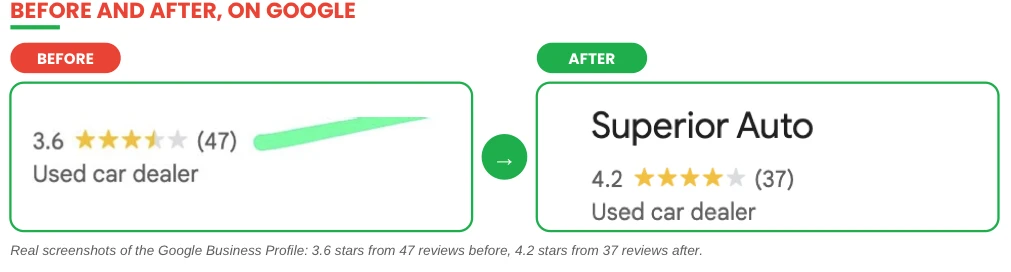
What clients say on Google
Reviews from the Local SEO With Hassan Google Business Profile, word for word.
Used car dealers: common questions
Something else on your mind? Add it to the audit form and I’ll answer directly.
Why should my dealership invest in local SEO instead of just paying third-party car portals?
Third-party portals like CarGurus and Autotrader charge heavy monthly subscription fees and pit your inventory directly against competing dealers on the exact same listing screen. Local SEO builds permanent equity in your own brand and Google Business Profile. When a local buyer searches "used car dealership near me" or "used trucks [city]", ranking in the local 3-pack brings buyers straight to your website and physical showroom without per-lead commissions.
How does Google’s "Cars for sale" / Vehicle Listings feature work?
Google enables automotive dealerships to sync their current vehicle inventory directly with Google Search and Maps. By connecting an automated inventory feed (CSV, XML, or DMS integration), your available cars appear in an interactive vehicle carousel on your Google Business Profile. Shoppers can filter by make, price, and mileage directly on Google and click straight to your website’s vehicle detail page.
Can an independent used car lot compete against big franchise dealerships on Google Maps?
Yes. Google’s local algorithm ranks profiles based on relevance, proximity, and prominence—not who has the biggest showroom or marketing budget. Franchise dealers often rely on corporate marketing agencies that neglect local profile upkeep. An independent lot with a properly categorized listing, high review velocity, frequent lot photos, and localized website landing pages routinely outranks massive franchise stores in the map pack.
How do you handle sold cars so website visitors don’t hit 404 errors?
When an individual car sells, deleting its Vehicle Detail Page creates a broken 404 link that hurts search engine crawl efficiency. I configure your inventory architecture so sold vehicle URLs either display a clear "Vehicle Sold" banner with links to three similar in-stock alternatives, or automatically 301 redirect to the parent category (such as your used SUV or used pickup truck hub).
What should I do about unfair negative reviews from declined financing applicants?
Every dealership occasionally encounters frustrated shoppers whose credit applications were declined by lenders. I implement a two-step reputation defense: first, writing clear, professional review responses that express empathy without violating customer privacy; second, setting up automated SMS review requests sent to verified car buyers right after vehicle handover, so steady 5-star reviews keep your overall score strong and push negative feedback down.
How quickly does the missed-call text-back system respond to prospective buyers?
The system triggers an automated SMS within 15 seconds of any unanswered phone call. It informs the buyer that your sales team is currently assisting customers on the lot, provides a direct link to view your current inventory, and invites them to text back which vehicle make, model, or stock number they are interested in test driving.
Get a free audit for your used car dealer business
Tell me about your business and the area you want to win. You’ll get a short, plain-language review of where you stand and what to fix first.
- Your Google Business Profile, checked line by line
- Where you rank on the map across your service area
- Your website's service and location pages
- Reviews and listings compared with your top 3 competitors
- How fast your leads get a reply
Find out what's keeping you off the map.
The audit is free. You’ll know what to fix first, whether you work with me or not.