

Septic companies
SEO and Google Maps for septic companies
When a septic tank backs up or an escrow deal needs an urgent inspection, homeowners call the first company they find on Google. I help septic pumping and repair operators capture those high-margin emergency and routine service calls across every town they serve.
The gaps I usually find
The plan for septic companies
The services that usually matter most, in the order I'd typically start. Your audit decides the final plan.
- Local SEO managementOngoing map pack tracking, GBP updates, photo publishing, and citation upkeep across your regional service territory.Explore Local SEO management →
- AI website developmentHigh-speed mobile website architecture engineered to convert emergency homeowners and capture after-hours inspection requests.Explore AI website development →
- Review generationAutomated post-service review requests sent via SMS right as your technician finishes pumping the tank.Explore Review generation →
- Missed-call text-back & AI receptionistInstant automated text reply within 15 seconds of any missed call so emergency leads don’t dial your competitor.Explore Missed-call text-back & AI receptionist →
- Local Services AdsTop-of-Google Google Guaranteed badge placement to win immediate trust for high-ticket drain field and installation jobs.Explore Local Services Ads →
Real search patterns: emergency backups, maintenance, inspections and seasonality
Septic search traffic is divided into distinct customer mindsets with completely different urgency levels, search queries, and conversion timelines.
Marketing a septic pumping and repair company requires understanding the specific moments that trigger a homeowner to search Google for help. Unlike standard home services where customers spend weeks browsing options, septic customers divide into four distinct search patterns:
1. Urgent sewage emergencies: Queries like “emergency septic pumping near me”, “septic backing up into house”, or “septic alarm going off”. These homeowners are in active panic. They are not reading long blog posts or comparison shopping; they are clicking the first phone number they see in Google’s local 3-pack or Local Services Ads. If your listing displays 24/7 availability, transparent phone tracking, and an instant SMS response, you win the job.
2. Routine maintenance pump-outs: Queries like “septic tank pumping cost”, “how often to pump septic tank”, or “septic cleaning [city]”. Most health departments and wastewater authorities recommend pumping septic tanks every 3 to 5 years. These homeowners plan ahead, review Google star ratings, and seek honest, upfront explanations of pump-out fees, tank capacity, and disposal practices.
3. Real estate escrow inspections: Searches like “septic inspection for home sale [county]” or “Title V septic inspection near me”. Homebuyers, real estate agents, and sellers facing strict closing deadlines need certified septic inspectors who can locate tanks, assess drain field condition with cameras, and provide official compliance certification quickly.
4. Weather and seasonal spikes: Spring snowmelt, torrential autumn rains, and winter ground freezes create massive hydrostatic pressure on aging drain fields. Heavy saturation floods leach lines, causing sudden system failures. I structure your content calendar and Google Business Profile updates to capture emergency calls ahead of seasonal weather shifts while locking in recurring commercial grease trap and residential pumping contracts.
Backups & System Alarms
Triggered by high-water alarms, gurgling drains, and sewage backups. High-intent searches that convert instantly into emergency pump-out and mechanical repair calls.
Maintenance & Escrow Inspections
Regular 3-to-5 year maintenance pump-outs, riser installations, baffle replacements, and real estate inspection certifications that build a loyal, recurring customer base.
Multi-county coverage: ranking across rural townships and suburbs without physical shops
Most septic operators dispatch vacuum trucks from a single rural yard or industrial base, but their actual territory spans multiple counties, townships, and lake districts.
A common SEO mistake among septic contractors is creating a single “Service Areas” page that simply lists 30 township names in bullet points. Google treats thin lists of town names as low-quality boilerplate and will not rank your business when a homeowner searches from a town 25 miles away from your yard.
To establish real organic visibility across your entire dispatch territory, you need dedicated, comprehensive city and county landing pages. Each page serves as a localized authority hub engineered to capture search traffic for that specific geographic jurisdiction:
• Soil and geological characteristics: Referencing regional soil compositions (e.g., heavy clay soils, sandy loam, high water tables, or ledge rock) that affect drain field absorption and perk test outcomes in that specific municipality.
• Local environmental regulations: Explaining township health board requirements, environmental conservation rules, and mandatory inspection cycles for that specific county.
• Dispatch and response times: Outlining normal dispatch windows, emergency vacuum truck availability, and regular route schedules for that sector.
• Geotagged project photography: Showing your pump trucks, excavators, and technicians completing real jobs, installing risers, or replacing distribution boxes in that specific community.
• Localized schema markup: Using precise JSON-LD structured data connecting your business entity to the target township name and geographic boundary.
By pairing this architecture with internal linking from your homepage and my AI website development architecture, your site earns top organic positions across your full service radius.
Proof from a similar home-service, multi-city business: Bay Area Sanitation
While every trade has unique operational nuances, multi-location search mechanics remain consistent. Here is documented proof from my campaign for Bay Area Sanitation, a regional sanitation and equipment company.
When I took over local search for Bay Area Sanitation in February 2026, the company operated across multiple regional cities but struggled to rank outside its primary depot. Competitive terms like “porta potty rental san jose” were trapped on page two at position #15, while Oakland searches sat down at #9.
I executed a multi-location SEO strategy: restructuring dedicated city landing pages, eliminating technical crawl errors, updating local schema markup, and implementing an aggressive Google Business Profile management routine. The results compounded rapidly across competitive municipalities:
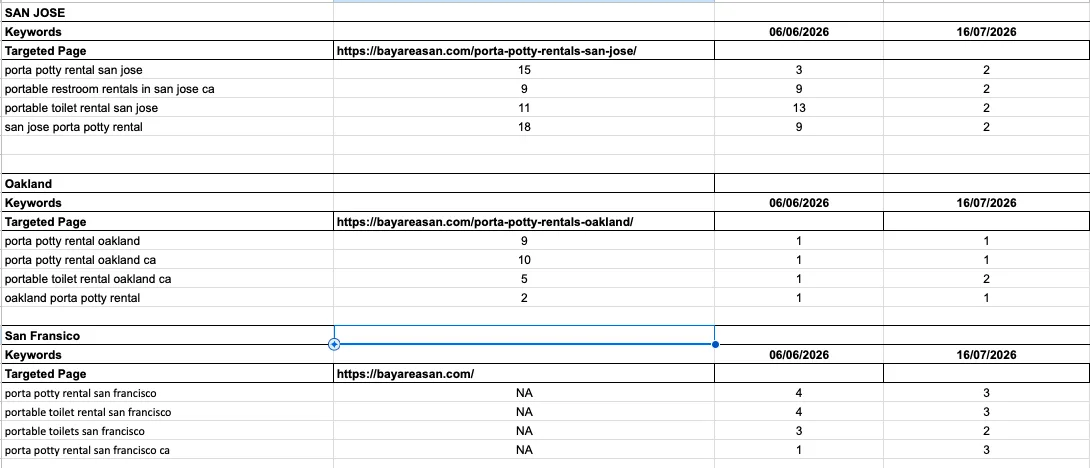
Multi-City Dominance: #1 Across Oakland and #2 in San Jose
Documented keyword ranking progress from the live rank-tracking sheet between campaign launch in February 2026 and July 2026.
- All 8 tracked Oakland keywords reached #1 on Google after just the first month (Feb → Mar 2026).
- Main San Jose keyword jumped from #15 to #2 on Google (Feb → Jul 2026).
- Monthly phone calls grew from 25 to 56 in just two months (June → August 2026).
- +107% more customer searches displayed the Business Profile in Feb–Jun 2026 compared to 2025.
Google Business Profile setup for a service-area septic contractor
Setting up and maintaining a Google Business Profile for a septic pumping business requires strict adherence to Google’s Service-Area Business (SAB) rules.
Most septic contractors park their vac trucks and store equipment on rural acreage, in an industrial yard, or at a home office. Because homeowners do not haul their sewage to your depot in a bucket, Google classifies septic businesses strictly as Service-Area Businesses.
Under Google guidelines, an SAB must toggle the physical street address to hidden. Displaying a residential address or an unstaffed equipment yard without permanent customer-facing signage and on-site staff available during posted business hours invites immediate profile suspension.
Here is how I structure and optimize your service-area profile for maximum map pack visibility:
• Primary category precision: Designating “Septic system service” as your primary category, reinforced by secondary categories like “Plumber”, “Drainage service”, and “Excavating contractor” where relevant.
• Strategic service territory definition: Carefully adding target cities, counties, and postal codes that reflect your realistic dispatch territory without exceeding Google’s recommended boundaries.
• Comprehensive service catalog: Adding detailed individual services for Septic Tank Pumping, Emergency Backups, Drain Field Repair, Septic Inspections, Riser Installation, Aerobic Treatment Units, and Baffle Replacement.
• Visual trust building: Uploading clean, professional photos of your branded vac trucks, pump equipment, clean uniform technicians, and completed riser installations to reinforce legitimacy.
Never use a PO Box, virtual mailbox, or residential home address as a public storefront listing. Doing so triggers hard suspensions that take weeks to resolve. Keep your address hidden and let your verified service radius and localized website pages drive your map rankings.
Local Services Ads & missed-call text-back: capturing every emergency call
Ranking on Google Maps generates high-intent inquiries, but pairing map pack visibility with Google Guaranteed ads and instant text automation ensures zero lost revenue.
In the septic industry, speed-to-lead is everything. Homeowners dealing with overflowing toilets or sewage backups call contractors in rapid succession until someone answers. Relying solely on voicemail guarantees lost revenue.
I deploy a two-part lead capture engine to maximize your conversion rate:
1. Google Local Services Ads (Google Guaranteed): LSAs appear above traditional Google Ads and the map pack. By completing background checks, license verification, and insurance compliance, your business earns the green Google Guaranteed badge. You pay strictly per qualified inbound phone lead, and fake or out-of-area calls can be disputed and refunded.
2. Automated missed-call text-back: When your crew is actively pumping a tank, operating an excavator, or driving on the interstate, they cannot pick up the phone. My missed-call text-back system detects an unanswered call and instantly fires an SMS within 15 seconds: “Hi, this is [Company]. Sorry I missed your call—are you experiencing an emergency backup or looking to schedule a routine pump-out?”
This immediate response reassures the homeowner, stops them from calling the next septic company on Google Maps, and allows them to text back their address and issue immediately.
Systematic review acquisition: building five-star trust after every pump-out
Customer reviews are one of the most powerful prominence factors in Google’s local ranking algorithm. Here is how I help you systematically gather authentic 5-star reviews.
Homeowners rarely remember to leave a review for a septic contractor unless they had an exceptional experience or a catastrophic disaster. To maintain steady review velocity that outpaces competitors, you need an automated, low-friction review process.
The best moment to ask for a review is immediately upon job completion, while the customer is relieved that their plumbing is functioning perfectly again. I implement a review generation workflow that sends an automated text message containing a direct Google review link right as the technician closes out the digital work order.
The SMS asks a simple, focused question: “Thanks for choosing [Company] today! Were our technicians professional, on time, and clean with your yard?” When customers respond positively, they are directed straight to Google to submit their rating. I also configure automated keyword-rich review responses to reinforce your topical authority and local relevance in Google’s algorithm.
Things I plan around
- Septic pumping is a mobile service-area business (SAB). Google strictly requires hiding the physical yard address unless residential homeowners routinely visit your facility during posted business hours.
- Emergency pump-outs and drain field failures require immediate response times. Over 80% of distressed homeowners hire the first business that answers their phone or responds via SMS.
What I track
What clients say on Google
Reviews from the Local SEO With Hassan Google Business Profile, word for word.
Septic companies: common questions
Something else on your mind? Add it to the audit form and I’ll answer directly.
Can one septic company website rank across multiple counties without opening new shops?
Yes. By creating individual, high-quality township and county service pages with localized content, soil condition details, local regulations, and genuine job photos, a single website can rank organically at the top of Google across dozens of regional communities without triggering duplicate content penalties.
Should my septic business show its yard address on Google Maps?
In almost every case, no. Under Google’s Merchant Guidelines, if customers do not visit your equipment yard or tanker depot, your address must remain hidden as a service-area business. Displaying a residential address or unstaffed tanker yard risks an instant suspension.
How do you balance seasonal spikes with steady routine maintenance?
Septic demand surges in spring during ground thaws and heavy rains, and spikes again during holiday family gatherings. Meanwhile, regular 3- to 5-year maintenance pump-outs and real estate escrow inspections provide steady baseline work year-round. I build targeted content for both urgent repair emergencies and preventative maintenance to keep your trucks rolling every month.
What is missed-call text-back and why is it vital for septic operators?
When your operators are under a tank lid or driving a vac truck on the highway, they cannot safely answer the phone. Missed-call text-back automatically sends an SMS within 15 seconds: "Hi, this is [Company]. Sorry I missed your call—are you experiencing a septic emergency or do you need a routine pump-out?" This keeps the customer engaged and stops them from calling the next septic service on Google.
Are Google Local Services Ads (Google Guaranteed) worth it for septic companies?
Yes, especially for emergency repairs and drain field replacements. Local Services Ads appear at the very top of Google above standard search ads and the map pack. Because you only pay per valid phone lead and carry the green Google Guaranteed badge, LSAs deliver high conversion rates from homeowners facing immediate sewage backups.
How long does it take for a new service-area page to rank on Google?
New city and county landing pages typically index within 1 to 2 weeks. Depending on competitor density in that rural or suburban township, ranking on page one usually takes between 30 and 90 days as internal linking, citations, and authority signals take effect.
Get a free audit for your septic companie business
Tell me about your business and the area you want to win. You’ll get a short, plain-language review of where you stand and what to fix first.
- Your Google Business Profile, checked line by line
- Where you rank on the map across your service area
- Your website's service and location pages
- Reviews and listings compared with your top 3 competitors
- How fast your leads get a reply
Find out what's keeping you off the map.
The audit is free. You’ll know what to fix first, whether you work with me or not.